By James J. DiGiacomo
In the sacristy after Mass, a woman told me that she was very disturbed by something I had said during my brief homily. I was commenting on the Gospel reading in which Jesus says that the fields are white for the harvest and that we should pray that the Lord sends workers into the fields. I observed that there were two possible reasons for the alarming shortage of priests: 1) God is calling people, but they are not responding, or 2) there are people who feel called but are not accepted, such as women and married men. I then asked: “Are such people called? Only God knows for sure. So let’s pray that we listen to the Spirit.”
The parishioner (I’ll call her Virginia) objected to my bringing up the possibility of women being called to the priesthood, because Rome has pronounced any discussion of the issue as out of bounds. I replied that I was aware of this; but since I have yet to hear any personally convincing arguments against women’s ordination, I continue to wonder. And it was this very wondering that offended her! How could I, a priest, have any reservations when authority has spoken? And worse still, how could I even intimate such reservations from the altar?
Any attempt to explain my thinking was, of course, futile. Such a conversation was doomed from the outset and destined to go downhill, which it did. For this dispute was not just about women’s ordination but about something much more basic. It goes to the very heart of what it means to be a Catholic, and it sheds light on the divisions that presently trouble the church and threaten to tear it apart. Virginia and I are like two ships passing in the night, and we both have millions of companions on our respective vessels that seem to be drifting farther and farther apart.
It would be well to point out, at the outset, that we are not disagreeing about some article of the Creed or other basic dogma. As in other derivative issues, like artificial birth control, capital punishment and end-of-life care, the substance of the faith is not at stake. These questions are important but must be kept in perspective. And there should be room for serious adult Catholics to reflect, question and debate such issues without reading one another out of the church. This is not to say that one opinion is as good as another, or that sincerity is all that matters. We’re talking here about a search for truth. The question is, how should we search for the truth?
For Virginia, the answer is simple. Listen to those in authority, especially the pope and those around him, whose judgments are final and not subject to review. The reasons they give for their decisions are irrelevant; the only thing that matters is the source. Her attitude is based on genuine faith in the vicar of Christ, confident that any pronouncement emanating from the Vatican comes from God. Any attempt to question its validity is tantamount to a rejection of the faith. But for me, and others like me, there is a problem. We have these little gray cells that persist in working even after respected authority speaks. We can’t seem to turn these cells off, and we tend to wonder, to question, to speculate, to evaluate, to criticize. In short, we can’t help thinking; and if those of us who are priests think out loud, Virginia and her friends are scandalized. She thinks our job is to tell people when to stop thinking, instead of giving bad example and continuing to speak when we have all presumably heard the last word.
In the final analysis, it’s all about loyalty. How can you refuse to give unquestioning assent and still call yourself a loyal member of the church? Isn’t the very notion of loyal opposition a contradiction in terms? It depends. I question the wisdom of some church policies and disagree with some decisions, but I do not leave the church. I work within the community of believers, accepting and obeying regulations and procedures even as I try to do my little bit, preaching and teaching and writing, to change them by appealing to minds and hearts. I know enough church history to realize that down the centuries, fallible church leaders have made mistakes and pursued misguided policies, many of which have in time been corrected with the help of the Holy Spirit. I am often annoyed, sometimes disappointed and occasionally angry, but I try not to lose patience and I keep the faith. And there are millions more like me.
If these divisions among Catholics were found only in the pews, it would be bad enough. But they go all the way up through the clergy and the episcopacy. Everyone knows that there are litmus tests to be passed before priests can become bishops or bishops become cardinals. And there is a disturbing development going on in the seminaries and among the priests themselves. Many of the younger clergy find their identity in professing unquestioning assent to authority, and they explicitly differentiate themselves from those older priests who have failed to purge themselves of the disease of critical thinking.
There have always been careerists and climbers among the clergy who were willing to stifle individuality for the sake of advancement, but now there is a rising generation of priests who are moved not just by ambition but by a disturbing collectivism that narrows options for service and styles of leadership. These men are interested not in asking questions but in giving answers. Questions make trouble; answers provide assurance. Inquiring minds are not only annoying; they are superfluous. All the answers we need are ready at hand, supplied by documents and pronouncements that are self-justifying and need no validation.
This movement comes at a time when many Catholics are suffering from a loss of nerve. Empty convents and rectories, half-empty churches, closing schools, contracting parishes and sexual abuse scandals eat away at our confidence. There is an understandable hunger for stability, for certainty. Unity is sought through uniformity. Catechetical materials are vigorously scanned and blue-penciled. Stimulating topics and speakers are no longer welcome in parish halls. Adventuresome theologians are not just criticized; they must be silenced. All this amounts to a kind of intellectual circling of the wagons—a skill at which the clergy have often excelled.
All popular movements have their buzzwords, and this one is no exception. The patrons of mental somnolence have a favorite: serene. Sometimes serenity is a good thing, a mark of emotional health, as when Pope John Paul II, in his last hours, was described as serene in the face of approaching death. That was admirable, even inspiring. At other times the word is used to manipulate and to offer false comfort. Time and again during the last several years, when pronouncements from the Vatican provoked consternation and disbelief on the part of thoughtful Catholics, the papal spokesman advised one and all to welcome the latest bad news “in a spirit of serene acceptance,” or words to that effect.
This is not the kind of serenity that comes from inner strength or conviction, but rather that of Alfred E. Newman, the resident dunce of Mad magazine: “What, me worry?” Cheer up, everyone; cool it. If no one gets excited, then everything must be all right. But in the church today, everything is not all right. There are pressing needs to be addressed, policies to be reviewed, problems to be faced, dogmatisms to be challenged, issues to be taken off back burners and closed questions to be reopened. At such a time, being serene is just another way of being in denial.
At this moment in the life of the church, those who refuse to close their eyes, turn off their minds, and settle for slack-jawed certainty are in for some bad times. They look more and more like blue staters in a red-state church, as the true believers move into positions of power and influence and set out to silence the voices of reason.
We have been down this road before. A hundred years ago, Catholic biblical scholars were being harassed, threatened and discredited for questioning outdated, untenable interpretations of Sacred Scripture. Sixty years later, during the Second Vatican Council, they were vindicated, and their best work was endorsed as official Catholic teaching in the “Dogmatic Constitution on Divine Revelation.” Pierre Teilhard de Chardin (1881-1955), the French Jesuit paleontologist and religious thinker, never got to see his impressive body of work in print. He had to die first, so that friends and admirers might see to its publication. John Courtney Murray, S.J. (1904-67), the U.S. theologian, fared somewhat better. He lived to see his teaching on religious liberty vindicated by the council, but only after enduring years of enforced silence imposed by mediocre minds. In all these cases the operative force was fear—fear of confusing or disturbing the faithful. Such concern is not improper. What is mistaken is the attempt to maintain clarity by silencing voices and closing minds. In so doing, those who use these tactics create a desert and call it peace.
Today the Catholic Church stands at a crossroads. This is a time fraught with peril and possibility. There is a place for caution and prudence, but also a need for creativity and courage. A jumble of conflicting voices frightens the guardians of order, but we have more to fear from a false impression of unanimity achieved at the price of stifling the most active minds among us. It is a characteristic of many dysfunctional families that their members are unable to bring their differences to the surface and deal with them. Many noisy, quarrelsome households, on the other hand, are actually healthier.
Yes, Virginia, there is another opinion out there, and it’s all right. You do not have to agree with it, but try not to be shocked at its expression. It means you belong to a church that is not dead but alive, and where the little gray cells continue to grow and flourish in freedom.
James J. DiGiacomo, S.J., is the author of many books on religious education and youth ministry.
Sunday, November 18, 2007


Friday, November 16, 2007
Cheering crowd attends disputed ordination of two women as priests
Read this article and then, in contrast, read Archbishop Raymond Burke's statement about the ordination. His Excellency opines that:
Then ask yourself: Where is our God, who is a God of love, best represented?
By Michele Munz
ST. LOUIS POST-DISPATCH
11/12/2007
ST. LOUIS — To the Roman Catholic Church, the ceremony was not an ordination. In fact, it wasn't even Roman Catholic. But to two women and the approximately 600 people who came to cheer them on, history was made Sunday in St. Louis as the two became the first women ever in the city to be ordained as Catholic priests.
And the first ever, perhaps in the world, to be ordained in a synagogue.

Rose Marie Hudson, 67, of Festus, and Elsie Hainz McGrath, 69, of St. Louis, were ordained as priests by an organization called Roman Catholic Womenpriests, which defines itself "as an international initiative within the Roman Catholic Church."
Not only is the Archdiocese of St. Louis upset about the women participating in an ordination ceremony, but the church and others in the interfaith community were upset that the Central Reform Congregation, in the Central West End, hosted the event.
"The event of today is really very sad because the name Roman Catholic has been misused and misapplied," said Dr. Lawrence J. Welch, a Kenrick-Glennon Seminary theology professor. "There's been no ordination of Roman Catholic priests. In fact, there has been a profaning of something Roman Catholics believe is very sacred."
To members of the diverse crowd — the dozen ministers in robes and stoles of different colors, those wearing yarmulke, and some wearing buttons saying "God loves us, just ask her" — the ceremony showed unity and understanding.
"What a day, what an occasion, what a case, what a rabbi," said Patricia Fresen, the ordaining bishop with Roman Catholic Womenpriests, referring to the synagogue's rabbi, Susan Talve. The room boomed with applause.
Fresen, from Germany, told the audience how when she saw the St. Louis Arch, she asked what it was for. She was told it was the symbol for the Gateway to the West.
She added: "For us in St. Louis today, the Arch is a symbol for the gateway to justice and equality for women."
Hudson said that after she turned 60, she had thought she would never realize her calling of becoming a priest — a calling she said she's had since she was 14 — until she heard Fresen talk in April 2006 at the Ecumenical Catholic Church in Webster Groves.
Hudson told Fresen she wanted to be ordained, and Fresen began the process. Hudson enlisted the support of the local Catholic Action Network, a grass-roots group that works for social justice within the Catholic Church. It was there she met McGrath and learned of her calling, and they began their journey to ordination together.
The process brought them close — so close that they will co-pastor a faith community at First Unitarian Church of St. Louis in the Central West End. Their first service will be Dec. 1.
Three months ago, Hudson and McGrath were looking for a place to hold the ordination ceremony. After visiting several Protestant churches, they visited Central Reform at the suggestion of a friend. Talve immediately welcomed them, telling them that opening her sanctuary to them was what she was all about.
"It felt right," Hudson said. Talve's board agreed as well, unanimously agreeing to host the ceremony.
The action irked some. The Rev. Vincent Heir, who directs the Catholic Church's interfaith efforts in St. Louis, said the archdiocese will not participate in any more interfaith events if Central Reform Congregation is "a leading player." St. Louis Archbishop Raymond Burke, who has threatened to excommunicate Hudson and McGrath, asked Talve to reconsider hosting the ceremony.
Though she felt support among the throng of people there Sunday, Talve said, "There is still work to do, still conversations to have to help people to understand why we chose to do what we did. Hospitality outweighed other issues that presented a challenge."
As Hudson and McGrath welcomed hugs and congratulations in their new white vestments, Andrew Wolf, 34, of south St. Louis County, made his way to Hudson. He said that as a homosexual, he fell away from Catholicism when he was 17. He recently wanted to return but wasn't sure how — until Sunday.
"I look forward to coming to your service," he told her. "As a lifelong Catholic, you have given me hope."
...In addition to the sacrilege of the attempted ordinations to the Sacred Priesthood, there is added the sacrilege of any attempts by the women involved to offer the Holy Mass, after their supposed ordination. They have, in fact, announced that they will "co-pastor the Thérèse of Divine Peace Inclusive Community on Saturday at 4:30 p.m. beginning December 1, 2007," which will meet in Hope Chapel at the First Unitarian Church of St. Louis at 5007 Waterman Avenue. One has to suppose that they will attempt to offer the Holy Mass, a most grave offense against our Lord and His Church.
Need of Prayer for Those Involved
Given the most sacred nature of the sacraments which will be simulated, the women involved and any Catholic who knowingly and deliberately assists them risks the eternal salvation of their souls. They commit mortal sin. Because of the most grave, public and obstinate nature of the proposed act of attempted ordination, the Church automatically applies medicinal penalties to the parties who complete the act. Medicinal penalties, for example, excommunication and interdict, are aimed at calling the persons away from their sin and to reconciliation with Christ and His Church. The women involved have been duly admonished regarding the penalties which they will incur, should they proceed with the attempted ordination. Any medicinal penalties or censures incurred will be appropriately declared, so that the ecclesial status of the parties involved may be clear for all...
Then ask yourself: Where is our God, who is a God of love, best represented?
By Michele Munz
ST. LOUIS POST-DISPATCH
11/12/2007
ST. LOUIS — To the Roman Catholic Church, the ceremony was not an ordination. In fact, it wasn't even Roman Catholic. But to two women and the approximately 600 people who came to cheer them on, history was made Sunday in St. Louis as the two became the first women ever in the city to be ordained as Catholic priests.
And the first ever, perhaps in the world, to be ordained in a synagogue.

Rose Marie Hudson, 67, of Festus, and Elsie Hainz McGrath, 69, of St. Louis, were ordained as priests by an organization called Roman Catholic Womenpriests, which defines itself "as an international initiative within the Roman Catholic Church."
Not only is the Archdiocese of St. Louis upset about the women participating in an ordination ceremony, but the church and others in the interfaith community were upset that the Central Reform Congregation, in the Central West End, hosted the event.
"The event of today is really very sad because the name Roman Catholic has been misused and misapplied," said Dr. Lawrence J. Welch, a Kenrick-Glennon Seminary theology professor. "There's been no ordination of Roman Catholic priests. In fact, there has been a profaning of something Roman Catholics believe is very sacred."
To members of the diverse crowd — the dozen ministers in robes and stoles of different colors, those wearing yarmulke, and some wearing buttons saying "God loves us, just ask her" — the ceremony showed unity and understanding.
"What a day, what an occasion, what a case, what a rabbi," said Patricia Fresen, the ordaining bishop with Roman Catholic Womenpriests, referring to the synagogue's rabbi, Susan Talve. The room boomed with applause.
Fresen, from Germany, told the audience how when she saw the St. Louis Arch, she asked what it was for. She was told it was the symbol for the Gateway to the West.
She added: "For us in St. Louis today, the Arch is a symbol for the gateway to justice and equality for women."
Hudson said that after she turned 60, she had thought she would never realize her calling of becoming a priest — a calling she said she's had since she was 14 — until she heard Fresen talk in April 2006 at the Ecumenical Catholic Church in Webster Groves.
Hudson told Fresen she wanted to be ordained, and Fresen began the process. Hudson enlisted the support of the local Catholic Action Network, a grass-roots group that works for social justice within the Catholic Church. It was there she met McGrath and learned of her calling, and they began their journey to ordination together.
The process brought them close — so close that they will co-pastor a faith community at First Unitarian Church of St. Louis in the Central West End. Their first service will be Dec. 1.
Three months ago, Hudson and McGrath were looking for a place to hold the ordination ceremony. After visiting several Protestant churches, they visited Central Reform at the suggestion of a friend. Talve immediately welcomed them, telling them that opening her sanctuary to them was what she was all about.
"It felt right," Hudson said. Talve's board agreed as well, unanimously agreeing to host the ceremony.
The action irked some. The Rev. Vincent Heir, who directs the Catholic Church's interfaith efforts in St. Louis, said the archdiocese will not participate in any more interfaith events if Central Reform Congregation is "a leading player." St. Louis Archbishop Raymond Burke, who has threatened to excommunicate Hudson and McGrath, asked Talve to reconsider hosting the ceremony.
Though she felt support among the throng of people there Sunday, Talve said, "There is still work to do, still conversations to have to help people to understand why we chose to do what we did. Hospitality outweighed other issues that presented a challenge."
As Hudson and McGrath welcomed hugs and congratulations in their new white vestments, Andrew Wolf, 34, of south St. Louis County, made his way to Hudson. He said that as a homosexual, he fell away from Catholicism when he was 17. He recently wanted to return but wasn't sure how — until Sunday.
"I look forward to coming to your service," he told her. "As a lifelong Catholic, you have given me hope."
Thursday, November 15, 2007
Don Sante: the lady and the book
 Don Sante has now released a book "Il mio amore non è peccato: La storia e la battaglia del prete innamorato" ("My Love Is Not a Sin: The story and struggle of the priest in love", Mondadori, 94 p., 13 euros) where he reveals the name of his lady-love -- Tamara Vecil (see photo below) -- and talks about his personal experience as well as his views of mandatory celibacy in general. In the press conferences associated with the launching of the book, Don Sante has stated that he will form another association to support married priests.
On the same subject, folks should also be aware of this Italian married priests blog: http://sacerdotisposati.splinder.com/
Tuesday, November 13, 2007
...and expressing affection!
We thought that as a public service we would alert our brother priests and the sisters who love them to the variety of T-shirts, buttons, etc. available from Cafe Press to express our feelings. Just go to http://www.cafepress.com/ and type the word "priest" in the search engine, then browse the results. Because Cafe Press is dedicated to free speech, some of the search results may be offensive to those who would prefer to ignore, or at least not trivialize, the pedophilia crisis..but it also yields these gems:
 NOTE: This one is also available as a thong!!!


And, finally, the one I'm thinking about buying and wearing in honor
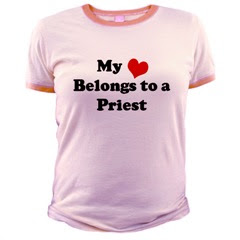
 NOTE: This one is also available as a thong!!!
The Franciscans also have specially dedicated T-shirts.
None of the other orders inspire quite the same level of individual affection


And, finally, the one I'm thinking about buying and wearing in honor
of the Pope's upcoming visit to our area:

Expressing opinions...
 The French bishops' conference just concluded their meeting in Lourdes and spent a large amount of time talking about the crisis in vocations in that country (Le Parisien, 11/11/2007). In France the number of diocesan priests has declined from 40,000 in 1965 to 15,957 en 2005, the last year for which statistics are available. There were only 98 new ordinands that year.
In spite of this, ordaining married men is not on the table for discussion, according to the bishops' conference. "L'idée que l'ordination des hommes mariés pourrait résoudre la crise des vocations est illusoire" ("The idea that ordaining married men could resolve the vocations crisis is illusory"), they said, citing Pope Benedict XVI's reaffirmation of the mandatory nature of celibacy.
Meanwhile, Cardinal Roger Etchegaray, the former president of the Pontifical Council for Justice and Peace, gave an interview in the same issue of Le Parisien (interview not available online; summary here) where he suggested that the ordination of married men, being a question of discipline and not doctrine, was open for discussion. But, the cardinal added, this is not the solution to the vocations crisis. Etchegaray believes the solution lies in a renewed appreciation for service to the Church.
In spite of this conclusion, Etchegaray's remarks were received as a positive sign by many married priests. In an article in the Italian newspaper La Stampa, "Ordinare preti sposati? Parliamone", don Giuseppe Serrone, president of the Associazione Sacerdoti Lavoratori Sposati (Association of Married Worker Priests) stated: "E’ una grossa apertura, confidiamo che sia il primo passo verso un cambiamento delle leggi della Chiesa." ("This is a great opening; we are confident that it is the first step toward a change of the laws within the Church.")
Photo: Cardinal Etchegaray and Pope Benedict XVI
Dark Ages return in Baltimore? (updated)
Baltimore’s new Roman Catholic archbishop removed a priest who was pastor of three South Baltimore parishes for offenses that include officiating at a funeral Mass with an Episcopal priest, which violates canon law.
Archbishop Edwin F. O’Brien personally ordered the Rev. Ray Martin, who has led the Catholic Community of South Baltimore for five years, to resign from the three churches and sign a statement yesterday apologizing for “bringing scandal to the church.”
Martin led the funeral Mass on Oct. 15 for Locust Point activist Ann Shirley Doda at Our Lady of Good Counsel with several clergy, including the Rev. Annette Chappell, the pastor of the Episcopal Church of the Redemption in Locust Point, Martin said.
Sean Caine, a spokesman for the Archdiocese of Baltimore, said this was one example of repeated administrative and liturgical offenses Martin had committed in more than a year.
“Father Martin’s received advice and counsel on numerous occasions from the archdiocese, and he has repeatedly violated church teaching,” Caine said.
Chappell did not participate in the consecration of the Eucharist but read the Gospel at the service, Martin said. Someone at the service reported to the archdiocese that Martin gestured to Chappell to take Communion, though Martin said he did not recall doing so.
Only ordained priests and deacons may read the Gospel at Mass, and non-Catholics may not receive Communion.
“I think that canon laws exist to protect the church from extremism. I don’t find that this is such an extreme situation,” Martin said.
Joyce Bauerle, a longtime friend of Shirley Doda, said having Chappell at her friend’s funeral service was a beautiful, ecumenical tribute to a woman who battled the status quo.
“What, are we in the Dark Ages again? This is absolutely ridiculous,” Bauerle said.
Victor Doda, who now operates the family funeral home, said he learned of Martin’s fate after conducting a funeral with him. . . .
“This ruins my mother’s legacy,” he said. “My mother would be turning in her grave to know that a priest was being victimized like this.”
Archbishop Edwin F. O’Brien personally ordered the Rev. Ray Martin, who has led the Catholic Community of South Baltimore for five years, to resign from the three churches and sign a statement yesterday apologizing for “bringing scandal to the church.”
Martin led the funeral Mass on Oct. 15 for Locust Point activist Ann Shirley Doda at Our Lady of Good Counsel with several clergy, including the Rev. Annette Chappell, the pastor of the Episcopal Church of the Redemption in Locust Point, Martin said.
Sean Caine, a spokesman for the Archdiocese of Baltimore, said this was one example of repeated administrative and liturgical offenses Martin had committed in more than a year.
“Father Martin’s received advice and counsel on numerous occasions from the archdiocese, and he has repeatedly violated church teaching,” Caine said.
Chappell did not participate in the consecration of the Eucharist but read the Gospel at the service, Martin said. Someone at the service reported to the archdiocese that Martin gestured to Chappell to take Communion, though Martin said he did not recall doing so.
Only ordained priests and deacons may read the Gospel at Mass, and non-Catholics may not receive Communion.
“I think that canon laws exist to protect the church from extremism. I don’t find that this is such an extreme situation,” Martin said.
Joyce Bauerle, a longtime friend of Shirley Doda, said having Chappell at her friend’s funeral service was a beautiful, ecumenical tribute to a woman who battled the status quo.
“What, are we in the Dark Ages again? This is absolutely ridiculous,” Bauerle said.
Victor Doda, who now operates the family funeral home, said he learned of Martin’s fate after conducting a funeral with him. . . .
“This ruins my mother’s legacy,” he said. “My mother would be turning in her grave to know that a priest was being victimized like this.”
Saturday, November 10, 2007
Catholic Church faces priest shortage
By Tony Castro, Staff Writer
L.A. Daily News
11/10/2007 12:18:46 AM PST
On a recent Sunday, the Rev. Robert J. McNamara of St. Bernardine of Siena Parish in Woodland Hills found himself baptizing four babies - all boys - and quipped that perhaps they would all grow up to be priests.
"The joke bombed," McNamara recalls. "The parents looked at me stone-faced. I even tried the joke a second time. It bombed a second time."
But it is no laughing matter in the Roman Catholic Church, which today finds itself with an all-time shortage of priests - so much so that many dioceses in the country are looking to Latin America to recruit seminarians.
"We, unfortunately, are typical of the trouble the church is having in recruiting men for the priesthood," said the Rev. Jim Forsen, who was ordained 28 years ago and is now vocations director for the Roman Catholic Archdiocese of Los Angeles.
Forsen makes the rounds of parishes, speaking during the homily about the joys of a religious vocation with the charisma befitting a college football recruiter.
At St. John Eudes Church in Chatsworth, for instance, he summoned all the children at the Mass to the altar and asked who among them wanted to be a lawyer, a dentist, a firefighter, a teacher, a doctor or a veterinarian.
Children eagerly raised their hands at each profession.
"How many of you want to be a priest?" Forsen finally asked.
He was greeted with a round of nervous giggles and laughter - but no hands.
He then prodded the altar boys. Still no takers.
"Don't you want to be a priest?" he asked one of the boys who shrugged. "Sure? Maybe? No way?"
Los Angeles, the largest archdiocese in the country, has fewer than 400 diocesan priests to minister to more than 4.3million Catholics, according to its Web site.
In the next five years, the San Fernando Region of the diocese, much of which is made up of the San Fernando Valley, will have an estimated 40percent fewer pastors than it does today.
At St. John's Seminary in Camarillo, the seminary for the Los Angeles Archdiocese, only 45 of the 92 seminarians are earmarked as future priests for this archdiocese, which encompasses L.A., Ventura and Santa Barbara counties.
"For almost all men who are considering the priesthood," Forsen is quick to acknowledge, "the main difficulty is celibacy."
But that's only one of the issues for the priest shortage. Across the country, religions that don't require celibacy are experiencing a shortage, as well.
Jewish synagogues and Protestant churches are reporting similar problems in recruiting rabbis and ministers. Some Episcopal and Presbyterian churches have a clergy shortage, and some congregations of Reform Judaism and the modern Orthodox wing of Judaism are without full-time rabbis.
For Protestant denominations, the declining clergy population has been blamed on the attraction of more lucrative careers in the private economy as well as retirements. For Jews, until a few years ago there were more rabbis than congregations, and officials say recruitment was not emphasized, causing their shortage.
But the Byzantine rite Catholic Church and the Orthodox Church, which allow their priests to be married before ordination, get plenty of vocations.
For the Roman Catholic Church, however, the clergy number across the country has been falling some 26percent since 1980, according to reports.
The archdioceses of Omaha and Atlanta, each of which serves about 250,000 Catholics, average around seven vocations a year each. In 1999, the Los Angeles Archdiocese recruited three men for the priesthood. Since then, the number has varied from none in 2001 to six in 2000 and 2004.
St. John's ordained nine seminarians in September, five of whom were assigned to Los Angeles.
According to a study by the Georgetown University-based Center for Applied Research in the Apostolate, celibacy ranks as the main reason for the dwindling numbers of priests, along with the attraction of successful, private lives.
"Our culture also places an emphasis on living a full, active sexual life; the priesthood calls one to chaste celibacy," Forsen said.
"The priesthood is, as it always has been, countercultural - not anti-cultural but clearly countercultural. The more countercultural our parishes and families become, the more likely it is that young people will want to live committed countercultural lives as priests and religious."
Lost in concerns over the priest shortage and the reasons behind it is the belief that the priesthood is a calling from God.
"Let us at least begin to see it as a possibility that God may be calling some of the young people we know to serve him as a priest or sister," McNamara wrote in his church's Sunday bulletin about his recent experience with parents who didn't want their infants growing up to become priests.
But Forsen says the challenge the church faces is connecting with youngsters. He tells the story about a high school principal who cautioned him about reaching out to her students for vocations.
"Good luck, Father. You priests do not live in the imagination of the young," the principal told Forsen. "They dream about being astronauts, or professional ballplayers, or rock stars, or even video-game designers.
"But they don't dream about being priests. You're not even on their radar."
Possible solutions, Forsen says, include taking steps to make Catholic life in general, and priestly and religious life in particular, attractive and spotlighting vocations as priorities - undoubtedly made more difficult in the wake of the clergy sex-abuse scandal that has rocked the church.
"A lot of people see only the sacrifices that go into the priesthood - the vows of poverty, chastity and obedience," he said. "There are people who ask, `How can you be a priest?' And to them I say, `How can you be married?' My point is that when you love, there is no sacrifice at all.
"It's the same with a priest. I feel that as a priest, I am trying to change the world for the good, and I am doing it for the same reason as people who are married. You are doing it for your kids."
L.A. Daily News
11/10/2007 12:18:46 AM PST
On a recent Sunday, the Rev. Robert J. McNamara of St. Bernardine of Siena Parish in Woodland Hills found himself baptizing four babies - all boys - and quipped that perhaps they would all grow up to be priests.
"The joke bombed," McNamara recalls. "The parents looked at me stone-faced. I even tried the joke a second time. It bombed a second time."
But it is no laughing matter in the Roman Catholic Church, which today finds itself with an all-time shortage of priests - so much so that many dioceses in the country are looking to Latin America to recruit seminarians.
"We, unfortunately, are typical of the trouble the church is having in recruiting men for the priesthood," said the Rev. Jim Forsen, who was ordained 28 years ago and is now vocations director for the Roman Catholic Archdiocese of Los Angeles.
Forsen makes the rounds of parishes, speaking during the homily about the joys of a religious vocation with the charisma befitting a college football recruiter.
At St. John Eudes Church in Chatsworth, for instance, he summoned all the children at the Mass to the altar and asked who among them wanted to be a lawyer, a dentist, a firefighter, a teacher, a doctor or a veterinarian.
Children eagerly raised their hands at each profession.
"How many of you want to be a priest?" Forsen finally asked.
He was greeted with a round of nervous giggles and laughter - but no hands.
He then prodded the altar boys. Still no takers.
"Don't you want to be a priest?" he asked one of the boys who shrugged. "Sure? Maybe? No way?"
Los Angeles, the largest archdiocese in the country, has fewer than 400 diocesan priests to minister to more than 4.3million Catholics, according to its Web site.
In the next five years, the San Fernando Region of the diocese, much of which is made up of the San Fernando Valley, will have an estimated 40percent fewer pastors than it does today.
At St. John's Seminary in Camarillo, the seminary for the Los Angeles Archdiocese, only 45 of the 92 seminarians are earmarked as future priests for this archdiocese, which encompasses L.A., Ventura and Santa Barbara counties.
"For almost all men who are considering the priesthood," Forsen is quick to acknowledge, "the main difficulty is celibacy."
But that's only one of the issues for the priest shortage. Across the country, religions that don't require celibacy are experiencing a shortage, as well.
Jewish synagogues and Protestant churches are reporting similar problems in recruiting rabbis and ministers. Some Episcopal and Presbyterian churches have a clergy shortage, and some congregations of Reform Judaism and the modern Orthodox wing of Judaism are without full-time rabbis.
For Protestant denominations, the declining clergy population has been blamed on the attraction of more lucrative careers in the private economy as well as retirements. For Jews, until a few years ago there were more rabbis than congregations, and officials say recruitment was not emphasized, causing their shortage.
But the Byzantine rite Catholic Church and the Orthodox Church, which allow their priests to be married before ordination, get plenty of vocations.
For the Roman Catholic Church, however, the clergy number across the country has been falling some 26percent since 1980, according to reports.
The archdioceses of Omaha and Atlanta, each of which serves about 250,000 Catholics, average around seven vocations a year each. In 1999, the Los Angeles Archdiocese recruited three men for the priesthood. Since then, the number has varied from none in 2001 to six in 2000 and 2004.
St. John's ordained nine seminarians in September, five of whom were assigned to Los Angeles.
According to a study by the Georgetown University-based Center for Applied Research in the Apostolate, celibacy ranks as the main reason for the dwindling numbers of priests, along with the attraction of successful, private lives.
"Our culture also places an emphasis on living a full, active sexual life; the priesthood calls one to chaste celibacy," Forsen said.
"The priesthood is, as it always has been, countercultural - not anti-cultural but clearly countercultural. The more countercultural our parishes and families become, the more likely it is that young people will want to live committed countercultural lives as priests and religious."
Lost in concerns over the priest shortage and the reasons behind it is the belief that the priesthood is a calling from God.
"Let us at least begin to see it as a possibility that God may be calling some of the young people we know to serve him as a priest or sister," McNamara wrote in his church's Sunday bulletin about his recent experience with parents who didn't want their infants growing up to become priests.
But Forsen says the challenge the church faces is connecting with youngsters. He tells the story about a high school principal who cautioned him about reaching out to her students for vocations.
"Good luck, Father. You priests do not live in the imagination of the young," the principal told Forsen. "They dream about being astronauts, or professional ballplayers, or rock stars, or even video-game designers.
"But they don't dream about being priests. You're not even on their radar."
Possible solutions, Forsen says, include taking steps to make Catholic life in general, and priestly and religious life in particular, attractive and spotlighting vocations as priorities - undoubtedly made more difficult in the wake of the clergy sex-abuse scandal that has rocked the church.
"A lot of people see only the sacrifices that go into the priesthood - the vows of poverty, chastity and obedience," he said. "There are people who ask, `How can you be a priest?' And to them I say, `How can you be married?' My point is that when you love, there is no sacrifice at all.
"It's the same with a priest. I feel that as a priest, I am trying to change the world for the good, and I am doing it for the same reason as people who are married. You are doing it for your kids."
Thursday, November 08, 2007
Ordaining Women for a Change
 Another interesting article on women's ordinations... To me, the most fascinating and disturbing part of this story is Elsie McGrath's experience of taking diaconate preparation classes with her late husband only to be told that only he could actually go through with ordination as a deacon while she had to remain a laywoman.
The Church Ladies: Two St. Louis women will soon become ordained Catholic priests — and in a Jewish synagogue, no less.
By Kristen Hinman
River Front Times
Published: November 7, 2007
The usual ordination of a Roman Catholic priest takes place in a cathedral and includes a vow of obedience to clerical superiors. It then culminates in the sacred "laying on of hands," when the bishop presses his palms on the candidate's head. Keeping with 2,000 years of tradition, all the participants are male.
But a priesthood ordination that bucks all Catholic custom will take place in St. Louis on Sunday, November 11. There will be no oath of obedience uttered at the ceremony, and no brother clergy at the altar when Bishop Patricia Fresen lays her hands on two women: Rose Marie "Ree" Hudson, of Festus, and Elsie McGrath, of south St. Louis.
Catholic priests in attendance are likely to be few, and those who do turn out will not be "robed up," as one priest, who plans to come dressed in plain clothes, put it. The 3 p.m. Mass is scheduled to take place at the Central Reform Congregation, a St. Louis temple well-known for opening its sacred space to non-Jewish groups. "This is history," observes Ronald Modras, a professor of theology at Saint Louis University, who specializes in contemporary Christianity and Catholic-Jewish relations.
When the ceremony ends, Hudson, 67, and McGrath, 69, will join the ranks of 22 other American women already ordained as part of the so-called Roman Catholic Womenpriests Program. The controversial international movement took root June 29, 2002, when seven women were secretly ordained aboard a pleasure boat on the Danube River in Passau, Germany.
The service was an explicit violation of Canon Law 1024, which states: "Only a baptized male validly receives sacred ordination." It also ran afoul of the 1994 apostolic letter by Pope John Paul II, which declared that the "Church has no authority whatsoever to confer priestly ordination on women..." Now known as the "Danube Seven," the women were excommunicated by the Vatican.
Hudson and McGrath, though, are completely indifferent and unafraid that they, too, risk a similar fate. It is time, they say, that the Catholic Church becomes more inclusive. "Change," says McGrath, "is not going to happen unless we do something radical."
The women made certain to alert St. Louis Archbishop Raymond Burke of their plans. In an October 1 letter, they wrote: "We do not expect you to support us or condone our actions, but we pray that you may accept that God is calling us to priesthood and that the Spirit is preparing the way, in justice, for women as well as men to be called to priestly ministry."
The Archbishop did not respond, but did a send a letter to Rabbi Susan Talve, of the Central Reform Congregation, urging her to cancel the ceremony and intimating that it would harm Catholic-Jewish relations. Talve — whose board of directors approved of the Mass — in turn informed the Archbishop that the ordination wold go on. "The First Unitarian Church across the street housed us for sixteen years, so we have a long history of appreciating other people's hospitality," explains Talve. "It would be terribly unfortunate for the Catholic Church to make a decision on their relationship with all the Jewish community based on the actions of one congregation."
The Archdiocese did not return a phone call for comment.
There are some local priests who are supportive of allowing Hudson and McGrath to become women of the cloth. "We constantly have to be trying to figure out what would Jesus want us to do?" says a longtime priest in the Archdiocese, who spoke on the condition of anonymity. "This strikes me as something He would want."
Hudson and McGrath both have long histories of serving the Church and possess extensive religious academic credentials, including master's degrees. (Male candidates for the priesthood typically spend four years at a seminary, after college, though Jesuits and men of other religious orders can spend more than ten postgraduate years preparing.)
Both ex-Protestants, Hudson and McGrath each came to Catholicism through their husbands. McGrath says she felt her calling to the Church about ten years ago when she and her now-deceased husband, Jim, completed four years of deaconate prep classes. Women can take the course but cannot become full-fledged deacons. Leaving Jim at the altar for his ordination while she took a seat in a pew, was "absolutely agonizing," recalls McGrath. "It was like being stabbed in the heart."
Hudson and McGrath met in April 2006 and since then have studied liturgy under Bishop Fresen to finalize their priestly formation. A former South African nun who now resides in Germany, Fresen became a priest in 2003 and a bishop in 2005. She descends from the original "Danube Seven," who were ordained in 2002 by Rómulo Antonio Braschi, an Argentine bishop who had fallen out of favor with the Vatican and then left the Church.
While it may sound radical to many Catholics, the Womenpriest movement actually represents the culmination of more than 30 years of lobbying and activism by the Washington, D.C.-based Women's Ordination Conference (WOC). Many members of the interest group believe not only in women's ordination, but also that total reform of the Church is needed. They advocate for less hierarchy and more democracy, less political posturing and more diversity — and making celibacy for priests optional.
Hudson and McGrath, like some of their Womenpriest predecessors, plan to open a new place of worship — "a faith community," they call it — with those very tenets in mind. The women will go by their first names to parishioners and will begin the "Lord's Prayer" with "Our Mother, Our Father." Masculine imagery such as "Kingdom" and "Master" will not be used and anyone, regardless of sexuality and marital status, is invited.
"My hope for the new priests, Elsie and Ree, is that they'll be a light for people who have not felt welcome, who have felt on the margins of the Roman Catholic Church," says Gerry Rauch, a St. Louis member of the WOC's board of directors. "Those who have divorced and remarried, or those who are gay and lesbian and transgendered."
The first service at Hudson's and McGrath's Thérèse of Divine Peace Inclusive Community will take place at the First Unitarian Church of St. Louis at 4:30 p.m. on December 1, and weekly thereafter.
Jane Via, a Kirkwood native who now lives in San Diego, where she presides over the largest Womanpriest church in the U.S., is keeping Hudson and McGrath in her thoughts. Via is on "interdict" from her local archdiocese, a form of censure that prevents her from taking Communion in a Catholic church, among other things. Her "case" has also been referred to Rome for possible further punishment.
Via's advice to Hudson and McGrath: "Be faithful to the vision of a renewed priestly ministry at all costs, whatever the cost may be."
Wednesday, November 07, 2007
The Voice of an "Angel"
 Father Angel Garcia Rodriguez, founder of the much honored and respected Spanish NGO Mensajeros de la Paz, gave an interview in conjunction with the release in Madrid of a new book about his life by journalist Jesús Bastante Liébana in which he took on the Catholic hierarchy on a number of issues. An excerpt:
...El presidente de Mensajeros de la Paz fue más allá. También se mostró optimista ante la posibilidad de que las mujeres puedan ser ordenadas sacerdotes durante el pontificado de Benedicto XVI. Y es que, según destacó, este Papa «valora mucho a la mujer». «Creo que en cuatro o cinco años veremos a mujeres sacerdotisas», apuntó. Y aprovechó para censurar incluso el celibato: «Es una barbaridad tan grande como una catedral». El cura también dijo sentirse «a gusto rezando en una mezquita o en una iglesia católica», porque «no hay salvación sólo en la Iglesia Católica»...
Translation: ...The president of Mensajeros de la Paz (Messengers of Peace) went further. He also showed optimism that women could be ordained as priests during the papacy of Benedcit XVI. It's because, according to him, this Pope "values women a lot." "I think that in four or five years we will see women priests," he stated. And he took the opportunity to criticize celibacy as well: "It is a barbarity as vast as a cathedral." The priest also said that he feels "happy praying in a mosque or a Catholic Church" because "salvation is not only found in the Catholic Church."...
WOW!
Don Sante: a new career and a few problems
 I'm now getting e-mail updates in Italian from Giorgia, one of Don Sante's supporters, who has taken on the job of helping his network of friends keep up with him. For those who are new to this thread, Don Sante is the Italian priest who was suspended from his priestly duties and removed from his parish for publicly admitting his love for a woman and her son. Don Sante argues that he has never violated his celibacy vows and that canon law does not prohibit him from expressing his feelings.
On the good side, Don Sante has started a new job as a truck driver with Tognetto Costruzioni. The photo from our friends at Il Mattino di Padova shows Don Sante at the wheel of his new vehicle. Click on the newspaper name for additional photos of Don Sante on the job.
On the negative side, Don Sante received a letter containing four bullets and a note that said "uno per te, uno per la tua donna, uno per tuo figlio e uno nel caso qualcuno di voi riuscisse a scappare" ("one for you, one for your woman, one for your son, and one in case one of you manages to escape"). Obviously, this was turned over to the police for investigation and Don Sante's house has been under extra security.
Also negatively, the conference on divorced, separated, remarried and cohabitating Catholics' access to the Eucharist had to be postponed to December 1st and a new venue found because pressure was put on to deny Don Sante the use of the Sala Kursal where the conference was originally scheduled to be held earlier in November.
Don Sante's response to these incidents? "Me l'aspettavo, sono sereno. Colpa dei toni usati dal vescovo e dal mio successore". "I was expecting it; I am serene. I blame the tone used by the bishop and by my successor [for provoking these incidents]."
Tuesday, November 06, 2007
What do you want me to say — ‘I love you, Father?’
 by Brad McElhinny
Charleston Daily Mail
November 6, 2007
Spectacular news brought a tangle of complications.
Roger Switzer pulled aside a young woman, Jacquie Terhaar, and said, "I think I'm in love with you."
At first, she was speechless.
Roger Switzer was a Catholic priest.
Finally, Jacquie spoke.
"What do you want me to say -- ‘I love you, Father?' "
He said, "Well, do you?"
"Yes," she replied.
Their exchange in the conference room of a summer camp for the Catholic Youth Organization of Rochester, N.Y., kicked off a year of internal, professional and religious struggle -- and then 24 years of marriage.
Every love story has complications. Because Roger's professional and spiritual calling ruled out marriage, theirs had more than most.
Father Switzer had to ask himself a lot of questions: What is right with the church? What is right with my relationship with this woman? How do you reconcile your love of a woman with your love of God?
Jacquie Switzer, now an assistant principal at Hayes Middle School in St. Albans, has written about the difficult choices in a new, self-published book "Life With ‘Father:' One Man's Journey Into Light . . . And Love." The 132-page memoir is available through outlets such as Amazon.com and Borders. Switzer published the book with the help of a company called AuthorHouse.
Back in 1965, the couple dared not breathe a word to anyone -- much less publish a book.
At that moment in the conference room, they shared a hug.
"Then we went into kind of a robotic state," Jacquie said. "We had to carry on the business of the camp."
Their love had built quietly.
Roger, 32, had been ordained as a Catholic priest in 1959, had worked as an assistant pastor at St. Mary's Parish in Horseheads, N.Y., and then was transferred in 1964 to become director for the Catholic Youth Organization. All signs pointed to a life in the priesthood.
Jacquie, 24, was a Latin teacher at Our Lady of Mercy High School, her own alma mater in Rochester. She accepted a summer job as director of nearby Camp Stella Morris, which was run by the Catholic Youth Organization.
And that was how she first got to know Roger -- from across a desk.
"You felt like you knew him so long, having just met. He was down to earth. He had a great sense of humor, a genuine love of people. It all came out in a very simple way. He would look nice but was never overly concerned with worldly things. You immediately felt like he liked you."
Initially, it was all business. Jacquie took the camp job in the fall, received a business letter from Roger in March, visited briefly in April to discuss progress in preparing for the summer and then showed up for her job as the summer began.
At the camp, she and Roger would have informal managerial meetings. They would share a coffee and talk casually.
"That essentially was our dating time or getting to know one another time," she said. "It was just this relating."
Once, when a chaplain -- who was a mutual friend -- came to visit the camp, he commented, "You have to be careful. Jacquie is the kind of person that you could fall in love with."
Roger thought: "Too late; already have."
The first people Jacquie and Roger told were her mother and father. They met at her parents' cottage not far from the camp. The couple explained that they were in love, that they planned to get married -- and that there was just one hangup.
Her father commented, "Yep, you do have a problem."
And then, as the summer camp came to a close, Roger returned to his organization's headquarters in Washington, D.C., while Jacquie returned to her teaching job at Our Lady of Mercy.
Their courting continued through the U.S. mail. In a series of letters to Jacquie, Roger described his conflict over how to move forward, his initial hope that the Catholic Church might change its policy on the celibacy of priests and his revelations, first to close friends and then to church hierarchy, about his dilemma.
Excerpts from the letters form the heart of Jacquie's book. She was inspired to write the book a couple of years ago after digging out the letters and reading them a day at a time, in the order that they had originally arrived.
"I saw this stream of a struggle, an anguish over this decision," said Jacquie, who is now 65. "I thought this would be a great story."
Roger spent about a year trying to untangle the situation. He still hoped to somehow stay in the priesthood while also marrying.
"There is no doubt in my mind my love for you," he told Jacquie. "Now the question is what do I need to do."
Friends in the church intervened on his behalf, asking the hierarchy what could be done. Roger met with a Cardinal in Baltimore to discuss the matter, but it was discouraging. He read books like, "Priestly Celibacy and Maturity."
For Jacquie, the situation was simpler. While Roger struggled over his decision, she just had to wait for him to make it.
She told him, "I don't want you to come back and say 10 years from now, ‘You made me leave the priesthood.' "
As the months passed, there was little progress to allow Roger to have life both ways. Finally, word came from the church: We have done everything we can. If you have made your decision, you have done everything you can. You need to leave.
"Roger was essentially fired," Jacquie said.
He still boldly predicted that within 10 years, the church would reverse its policy on priestly celibacy.
The couple married Sept. 3, 1966, in a private ceremony at her parents' house. Twelve people attended.
A friend from graduate school helped Roger find a new job in West Virginia. The Switzers moved to Charleston, where he became the director for Family Service of West Virginia. In later years, he worked as executive director of the Community Council of the Kanawha Valley and then was the director of the Charleston Housing Authority for 19 years.
The couple had six children -- Andrew, Michael, Anne Marie, David, John and Richard. The boys were all named for priests who had helped them through their ordeal.
Roger and Jacquie never regretted the difficult decision they had made.
"To me, it's awesome you can participate in the creation of a human being, and the commitment of yourself body and soul to another human being is awesome," Jacquie said.
"It's a gift from God -- the participation of human beings in the creation of individuals."
The family remained Catholic. They attended St. Agnes in Kanawha City, Sacred Heart in Charleston and Blessed Sacrament in South Charleston, largely depending on where in the Kanawha Valley they happened to live at the time. Roger didn't tell his fellow parishioners about his time as a priest unless they happened to ask.
Even as he moved on with his life, Roger had remaining issues with the church. He never received a response from his petition for a dispensation from his vow of celibacy. He also wanted his marriage to be regularized. He hoped to be assured of a Christian burial, and felt there was no guarantee given the strife the family had been through.
He did not receive a written response, but he did get an answer.
In 1990, Roger was diagnosed with colon cancer. Treatment provided no cure. He resigned from his job at the housing authority in September and died in late November. He was 57.
His worries about how he and his family would be buried were put to rest. He had a Catholic service at St. Patrick's Cemetery. The eulogy was given by a friend who had been with the couple when they first decided to wed. He, too, had left the priesthood to marry.
To Jacquie, the funeral was a sign of how far people had come. Although the church still had not changed its policies, people had become far more accepting. It was a stark contrast from the secret they had to keep when they first confessed their love for each other.
In the limousine on the way to the service for the former priest Jacquie commented to her six children, "Here we are headed to St. Patrick's Cemetery, and nobody really cares."
Saturday, November 03, 2007
Married Catholic priests would ease shortage
By Roger Chesley
The Virginian-Pilot
November 3, 2007
God bless our overworked Roman Catholic priests. Their ranks keep thinning, the pews keep filling and dioceses across the nation are scrambling to meet the needs of the faithful.
Whether it's having one priest serve several "clustered" parishes, recruiting more permanent deacons, or increasing the roles of the laity, the Catholic Church hierarchy is struggling to find the right combination to minister to an ever-growing number of parishioners. Especially in this country, single Catholic men aren't seeking the often-austere, task-laden lives of the priesthood.
An article this week by The Pilot's Steven Vegh discussed the push by the Catholic Diocese of Richmond to boost the ranks of deacons, the ordained male clergy who can administer some sacraments but cannot do all the functions handled by priests. Deacons can be married.
A suggestion, one I've mentioned before: Allow married priests. (Though I'm a married Catholic, it's not something I'd seek personally.) A majority of U.S. Catholics favors the change, according to surveys.
I know, I know, the church is not a democracy. And the priest shortage in the United States is not as acute as in other countries, such as Mexico and in parts of Asia and Africa.
Nor am I referring to the handful of priests who were married when they converted from other faiths - mainly Episcopal or Lutheran - to Catholicism. They number only about 100, said Sister Mary Ann Walsh, spokeswoman for the U.S. Conference of Catholic Bishops.
But it's clear the Catholic Church needs additional help on the altar. In 1975, there were 58,900 diocesan and religious priests in the United States, according to the nonprofit Center for Applied Research in the Apostolate. Today, there are 41,449. Meanwhile, the number of Catholics has exploded, from 48.7 million in 1975 to 64.4 million today.
Priests who have left the active ministry to marry, or those married Catholics who want the option of becoming priests, could do a great service for the faith. They would gain spiritually, and they could ease the workload of current priests.
At least the possibility of married priests was discussed two years ago, shortly after Pope Benedict XVI's tenure began, during the Synod of Bishops. The advisory body grappled with the worldwide priest shortage and whether celibacy was necessary.
In the end, church policy was not altered, but "the fact that [open discussion] even happened is significant," said James D. Davidson, sociology professor at Purdue University and one of four authors of the recently released book, "American Catholics Today."
"The idea to expand the pool of people eligible for the priesthood" has gained in intensity in recent decades, he told me by phone Thursday. "Catholics put a value on the sacrament. They see the decline of priests as a potential threat to their ability to get communion or last rites," also called anointing of the sick. Priests, not deacons, must administer the anointing and consecrate bread and wine for Holy Communion.
I might not see the change in my lifetime - the Catholic Church moves glacially. But married Catholic men should have the option of becoming priests.
Roger Chesley is associate editor of The Pilot's editorial page. Reach him at (757) 446-2329 or roger.chesley@pilotonline.com.
The Virginian-Pilot
November 3, 2007
God bless our overworked Roman Catholic priests. Their ranks keep thinning, the pews keep filling and dioceses across the nation are scrambling to meet the needs of the faithful.
Whether it's having one priest serve several "clustered" parishes, recruiting more permanent deacons, or increasing the roles of the laity, the Catholic Church hierarchy is struggling to find the right combination to minister to an ever-growing number of parishioners. Especially in this country, single Catholic men aren't seeking the often-austere, task-laden lives of the priesthood.
An article this week by The Pilot's Steven Vegh discussed the push by the Catholic Diocese of Richmond to boost the ranks of deacons, the ordained male clergy who can administer some sacraments but cannot do all the functions handled by priests. Deacons can be married.
A suggestion, one I've mentioned before: Allow married priests. (Though I'm a married Catholic, it's not something I'd seek personally.) A majority of U.S. Catholics favors the change, according to surveys.
I know, I know, the church is not a democracy. And the priest shortage in the United States is not as acute as in other countries, such as Mexico and in parts of Asia and Africa.
Nor am I referring to the handful of priests who were married when they converted from other faiths - mainly Episcopal or Lutheran - to Catholicism. They number only about 100, said Sister Mary Ann Walsh, spokeswoman for the U.S. Conference of Catholic Bishops.
But it's clear the Catholic Church needs additional help on the altar. In 1975, there were 58,900 diocesan and religious priests in the United States, according to the nonprofit Center for Applied Research in the Apostolate. Today, there are 41,449. Meanwhile, the number of Catholics has exploded, from 48.7 million in 1975 to 64.4 million today.
Priests who have left the active ministry to marry, or those married Catholics who want the option of becoming priests, could do a great service for the faith. They would gain spiritually, and they could ease the workload of current priests.
At least the possibility of married priests was discussed two years ago, shortly after Pope Benedict XVI's tenure began, during the Synod of Bishops. The advisory body grappled with the worldwide priest shortage and whether celibacy was necessary.
In the end, church policy was not altered, but "the fact that [open discussion] even happened is significant," said James D. Davidson, sociology professor at Purdue University and one of four authors of the recently released book, "American Catholics Today."
"The idea to expand the pool of people eligible for the priesthood" has gained in intensity in recent decades, he told me by phone Thursday. "Catholics put a value on the sacrament. They see the decline of priests as a potential threat to their ability to get communion or last rites," also called anointing of the sick. Priests, not deacons, must administer the anointing and consecrate bread and wine for Holy Communion.
I might not see the change in my lifetime - the Catholic Church moves glacially. But married Catholic men should have the option of becoming priests.
Roger Chesley is associate editor of The Pilot's editorial page. Reach him at (757) 446-2329 or roger.chesley@pilotonline.com.
Sunday, October 28, 2007
Don Sante - suspended "a divinis"
 Yesterday's newspapers -- we're summarizing here from his hometown paper, Il Mattino di Padova -- brought the unfortunate news that Don Sante Sguotti has been completely suspended from all his priestly functions indefinitely by the bishop Mons. Antonio Mattiazzo. Don Sante is declining to appeal the suspension, describing this as a waste of time. Don Sante views the suspension as a merely bureaucratic step, not unexpected. "Nothing in my life has changed", he says, "I am still a priest." He continues to insist that his relationship with his lady friend has been chaste, that her baby is not his child biologically, and that the burden is on the Church to prove that he violated his celibacy vows. He maintains that he loves the woman and her child and does not see this statement as incompatible with being a priest.
Don Sante left the parish residence after 40 signatures (5% of the inhabitants of the community) were finally collected on a petition for his removal. The vast majority of the faithful continue to side with him.
Meanwhile Don Sante continues to work on a conference planned for November 16-18, "On the Road to Reconciliation" about the relationship of divorced, remarried and cohabiting Catholics to the Church.
Thursday, October 25, 2007
Vanity Uncovered
 The Suffering Servant
9x11 collage
In my vanity, I tried to collage a perfect face of Christ. I hoped for a Jesus with a beautifully serene expression and eyes full of love. Instead, after many tries and frustration, I ripped back the paper, and gave up. I waited some time, and when I finally gave myself permission to go back to the piece, there he was the Suffering Servant looking into my eyes. When I let go, and accepted my honest abilities, the process, and the outcome, I received more than I hoped for.I feel that the Holy Spirit was guiding the creation of this picture.
Is it our vanity that tries to make the church perfect? Or is it the vanity of church leaders that causes them to turn their faces away from the real people who are battered and torn? The church was never meant to be a great imposing Vatican structure. The church was not meant to be a white robed pontiff floating around somewhere in a pope-mobile away form the people and sprinkling rose petals at Marian shrines. The church is certainly not red robed men who live in luxurious homes protecting their images by covering up abuses. The church is people with messy lives filled with battering and suffering. I believe that the Holy Spirit is trying to guide the church to accept, and serve all the people. All of us, married priest, wives and children of priest, illegitimate children of priests, and abandoned women who have loved a priest, all belong to the church.
Marcella Paliekara
http://dailypaintingsbmp.blogspot.com/ or email me at myvisionsandvoices@yahoo.com
Wednesday, October 24, 2007
Don Sante's new digs -- poor but free
Some photos showing how Don Sante's getting along since being kicked out of his parish home. Actually the photo series on his removal and the arrival of his successor, Don Brusegan, in Il Mattino di Padova is very interesting. Don Sante welcomes his succesor warmly and looks confident and slightly amused while Don Brusegan looks increasingly uncomfortable. The photos also show Don Brusegan celebrating Mass with very few parishioners in contrast to a packed parish meeting with Don Sante. Don Sante's new digs -- labeled Chiesa Cattolica dei Peccatori on the outside -- are spartan but judging from the other photo with his supporters, he's a happy man. Don Sante is asking the Pope for dispensation from his celibacy vow but wants to remain a priest. 


Speaking out in Spain
Wonderful article from El Mercantil Valenciano, 10-24-2007. English translation below:
Un cura de Girona pide en la hoja parroquial que los sacerdotes puedan casarse
El cura de la parroquia del Carme de Manresa, Màrius Masoliver, pide en el suplemento de la hoja diocesana de esta semana que los sacerdotes puedan casarse y también la igualdad entre los hombres y las mujeres en el seno de la iglesia. Unas peticiones revolucionarias teniendo en cuenta que el obispado de Vic no pertenece a las tendencias progresistas de la Iglesia.
Masoliver da estos consejos al obispo, esperando que tenga el «coraje decidido y valiente» de hacer estas propuestas a Roma «con la actitud y el convencimiento de los auténticos profetas de siempre y sin miedo». Sobre la primera, el sacerdote pide «comprensión» por la opción personal de escoger el sacerdocio no célibe, ya que asegura que «son dos realidades que no siempre han ido juntas» y que no seria un « obstáculo» desde el punto de vista teológico.
Según el cura Màrius Masoliver, sería bueno que el sacerdote pudiera escoger «con plena libertad de espíritu, entre una de las tres opciones: celibato, matrimonio o soltería» .
Con igual contundencia asegura que no se ha de continuar situando el papel de la mujer en segundo término y que «es menester una reconsideración real y práctica» de esta igualdad, «incluido el acceso al ministerio» .
ENGLISH:
A pastor in Girona asks in the parish newsletter for priests to be allowed to marry
In the supplement to this week's diocesan newsletter, Màrius Masoliver, the pastor of Carme de Manresa parish, has called for priests to be allowed to marry and also for equality of men and women within the Church. These are revolutionary demands given that the bishop of Vic does not belong to the progressive wing of the Church.
Masoliver is giving this advice to the bishop, hoping that he will have the "decisive and valiant courage" to carry these proposals to Rome "with the attitude and conviction of the authentic prophets of all time and without fear". On the first question, the priest calls for "understanding" for a personal option of choosing non-celibate priesthood, since he states that "they are two separate situations that have not always gone together", and that there would be no "obstacle" from a theological perspective.
According to Father Màrius Masoliver, it would be good if the priest could choose "with complete spiritual freedom between three options: celibacy, marriage, and single life."
With equal force, he asserts that the role of women should not continue to be second place and this equality requires a real and practical reconsideration, including access to the ministry.
Un cura de Girona pide en la hoja parroquial que los sacerdotes puedan casarse
El cura de la parroquia del Carme de Manresa, Màrius Masoliver, pide en el suplemento de la hoja diocesana de esta semana que los sacerdotes puedan casarse y también la igualdad entre los hombres y las mujeres en el seno de la iglesia. Unas peticiones revolucionarias teniendo en cuenta que el obispado de Vic no pertenece a las tendencias progresistas de la Iglesia.
Masoliver da estos consejos al obispo, esperando que tenga el «coraje decidido y valiente» de hacer estas propuestas a Roma «con la actitud y el convencimiento de los auténticos profetas de siempre y sin miedo». Sobre la primera, el sacerdote pide «comprensión» por la opción personal de escoger el sacerdocio no célibe, ya que asegura que «son dos realidades que no siempre han ido juntas» y que no seria un « obstáculo» desde el punto de vista teológico.
Según el cura Màrius Masoliver, sería bueno que el sacerdote pudiera escoger «con plena libertad de espíritu, entre una de las tres opciones: celibato, matrimonio o soltería» .
Con igual contundencia asegura que no se ha de continuar situando el papel de la mujer en segundo término y que «es menester una reconsideración real y práctica» de esta igualdad, «incluido el acceso al ministerio» .
ENGLISH:
A pastor in Girona asks in the parish newsletter for priests to be allowed to marry
In the supplement to this week's diocesan newsletter, Màrius Masoliver, the pastor of Carme de Manresa parish, has called for priests to be allowed to marry and also for equality of men and women within the Church. These are revolutionary demands given that the bishop of Vic does not belong to the progressive wing of the Church.
Masoliver is giving this advice to the bishop, hoping that he will have the "decisive and valiant courage" to carry these proposals to Rome "with the attitude and conviction of the authentic prophets of all time and without fear". On the first question, the priest calls for "understanding" for a personal option of choosing non-celibate priesthood, since he states that "they are two separate situations that have not always gone together", and that there would be no "obstacle" from a theological perspective.
According to Father Màrius Masoliver, it would be good if the priest could choose "with complete spiritual freedom between three options: celibacy, marriage, and single life."
With equal force, he asserts that the role of women should not continue to be second place and this equality requires a real and practical reconsideration, including access to the ministry.
Where are All Our Letters?
 Joan Of Arc, One Betrayed and Abandoned By The Church
 I contacted this site long ago and asked where all the women married to priest were, and where were their voices. I did not get any answer. Reading the article “Fala Brazil! An Open Letter to Pope Benedict XVI” renewed my question. Good for these committed Catholics in Brazil. Where is our (concerned Catholics of the U.S.A.) letter to sign to send to Pope Benedict XVI?
I am a woman married to a priest who longs to be reconciled with the church. If I knew of a way to contact all the children, wives, and relatives of married priests, who were forced to make a choice between the priesthood and marriage, I would ask them to write a letter. I would ask them to write about how being a child, or a wife to these men has impacted their lives. I would ask them to write about how they feel that their father or husband would have to abandon them in order to be reconciled with the church. How would a choice such as this impact their lives? What do they long for, and maybe more importantly, what do they fear? What are the lives like of illegitimate children and women who have lived in the shadows abandoned because of a priest’s choice? I would include pictures of everyone along with signatures.
What a dreamer I am, but it would be great to have a group of these people go to the Vatican and present the letters. Let the pope look into their faces and say, "no, you are not going to be recognized, or reconciled", and turn them away. It is easy for the church to ignore people when they are signatures on a piece of paper, but a real face of a child, a wife, or a mother may have a greater impact.
I would be willing to do what I could to organize, write, contact, or what ever else it would take to get a letter together. You can find out more about me and reach me through my blog http://dailypaintingsbmp.blogspot.com/ or email me at myvisionsandvoices@yahoo.com .
Marcella Paliekara
I am a woman married to a priest who longs to be reconciled with the church. If I knew of a way to contact all the children, wives, and relatives of married priests, who were forced to make a choice between the priesthood and marriage, I would ask them to write a letter. I would ask them to write about how being a child, or a wife to these men has impacted their lives. I would ask them to write about how they feel that their father or husband would have to abandon them in order to be reconciled with the church. How would a choice such as this impact their lives? What do they long for, and maybe more importantly, what do they fear? What are the lives like of illegitimate children and women who have lived in the shadows abandoned because of a priest’s choice? I would include pictures of everyone along with signatures.
What a dreamer I am, but it would be great to have a group of these people go to the Vatican and present the letters. Let the pope look into their faces and say, "no, you are not going to be recognized, or reconciled", and turn them away. It is easy for the church to ignore people when they are signatures on a piece of paper, but a real face of a child, a wife, or a mother may have a greater impact.
I would be willing to do what I could to organize, write, contact, or what ever else it would take to get a letter together. You can find out more about me and reach me through my blog http://dailypaintingsbmp.blogspot.com/ or email me at myvisionsandvoices@yahoo.com .
Marcella Paliekara
Wednesday, October 17, 2007
Fala Brasil!: An Open Letter to Pope Benedict XVI
The following letter about married priesthood and Church reform written by 110 committed Catholic lay men and women in Brazil was published in Folha de S. Paolo on 9/28/2007 with an introduction signed by Carlos Alberto Roma, a former Franciscan seminarian. The text of the original in Portuguese can also be found here.
I want to add that it's interesting how lately the issues of priestly celibacy and the participation of divorced and remarried Catholics in the Eucharist have been united in the struggles for church reform around the world. This is one more example. And, by the way, the link mentioned at the end of this letter doesn't work.
As lay Catholics, our disatisfaction with the insensitivity of the hierarchy of our Church – that is, the Vatican – is growing.
The basic problem is the explicit lack of courage to take the necessary steps towards moving the Church into the 21st century, especially opening it to lay people.
We are taking a theological formation course. We are 110 lay people. After reflecting on Jesus’ courage and actions in the face of the religion of his time – using Br. Carlos Mesters’ book “Com Jesus na Contramão” as a basic text – we have decided to draft a letter to Pope Benedict XVI and the entire Roman Curia:
We are ever more motivated to serve God through our Church. In spite of this, we are suffering a lot because successive priests who function in our parish have a serious problem: As much as they try to motivate the young men of today, they are not inspired to enter seminary to serve as priests. We have also noted this problem in the old continent and have found that the situation there is even more dire.
We lay people ask forgiveness for daring to send this letter directly to Your Holiness, without going through the proper channels. It’s a very delicate matter and local [church] authorities do not have permission to discuss it. We are asking for this discussion to begin. During our Sunday celebrations, we have asked brothers and sisters in the parish and have found that over 95% understand that the Church needs to take new steps.
Brazil has the lowest ratio of Catholic priests in the world, according to the Centro de Estadística Religiosa e Investigações Sociais. Whereas in Brazil there are 18,685 priests (1 for every 10,000 people), in Italy there is 1 for every 1,000. In [the rest of] Latin America, the problem is also obvious. Argentina has 1 priest for every 6,800 people, and in Colombia there is 1 for every 5,600 people. The average for Mexico – the second most Catholic country in the world – is the one that comes closest to Brazil’s: 1 priest for every 9,700 people.
With the huge scarcity of priests, confirmed by studies in every country in the world, we are asking ourselves: why not admit married men and women into the priesthood and readmit married priests into service in the Church?
We know there have been 39 married Popes historically. The first was Peter the Apostle (Luke 4:38-39).
According to research by the Centro de Estadística Religiosa e Investigações Sociais (CERIS) published 1/31/06, there are about 5,000 married priests in Brazil who cannot exercise their ministry. Most of these men feel the vocation to the priesthood beating strongly in their hearts. Isn’t this an act of violence against the Lord of Life who sent missionaries for the labor?
Catholic priests were permitted to marry in the first millenium of the Christian era. It was the first two Lateran Councils in 1123 and 1139 that instituted priestly celibacy and abolished marriage for priests. The current times call us to make a courageous review and change our paradigms. We are asking Your Holiness to create a commission that also includes lay men and women to study and resolve four issues:
1) The development of two models of priesthood: a) celibate and b) married, with specific canonical norms for each state.
2) The development of a female priesthood with two modalities: a) celibate and b) married with specific norms for each state.
3) The reintegration of married men who still have a vocation into service in the Church.
4) Review the problem of Christians in second marriages and their participation in the Eucharist.
With respect to the above reflections, we feel called to an egalitarian participation in the journey of Church life, especially its future. We want to express our thoughts and expectations, stating that it is essential that the Church hierarchy hear our cry.
Will the hierarchy of our Catholic Church continue to be indifferent? Or will it be open to the Holy Spirit and step up? We cannot go backwards anymore in this debate. Are we perhaps lacking “ecclesial will” or “political decisiveness”?
We are proposing that all the cardinals, bishops, priests and lay people who work in the pastoral movements initiate this debate in their areas and have a thorough discussion of the issues above. Our group of lay people has a Web page:
www.softline.com.br/leigoscatolicosnacontramao
We invite all lay people who feel prophetic strength into this debate.
I want to add that it's interesting how lately the issues of priestly celibacy and the participation of divorced and remarried Catholics in the Eucharist have been united in the struggles for church reform around the world. This is one more example. And, by the way, the link mentioned at the end of this letter doesn't work.
As lay Catholics, our disatisfaction with the insensitivity of the hierarchy of our Church – that is, the Vatican – is growing.
The basic problem is the explicit lack of courage to take the necessary steps towards moving the Church into the 21st century, especially opening it to lay people.
We are taking a theological formation course. We are 110 lay people. After reflecting on Jesus’ courage and actions in the face of the religion of his time – using Br. Carlos Mesters’ book “Com Jesus na Contramão” as a basic text – we have decided to draft a letter to Pope Benedict XVI and the entire Roman Curia:
We are ever more motivated to serve God through our Church. In spite of this, we are suffering a lot because successive priests who function in our parish have a serious problem: As much as they try to motivate the young men of today, they are not inspired to enter seminary to serve as priests. We have also noted this problem in the old continent and have found that the situation there is even more dire.
We lay people ask forgiveness for daring to send this letter directly to Your Holiness, without going through the proper channels. It’s a very delicate matter and local [church] authorities do not have permission to discuss it. We are asking for this discussion to begin. During our Sunday celebrations, we have asked brothers and sisters in the parish and have found that over 95% understand that the Church needs to take new steps.
Brazil has the lowest ratio of Catholic priests in the world, according to the Centro de Estadística Religiosa e Investigações Sociais. Whereas in Brazil there are 18,685 priests (1 for every 10,000 people), in Italy there is 1 for every 1,000. In [the rest of] Latin America, the problem is also obvious. Argentina has 1 priest for every 6,800 people, and in Colombia there is 1 for every 5,600 people. The average for Mexico – the second most Catholic country in the world – is the one that comes closest to Brazil’s: 1 priest for every 9,700 people.
With the huge scarcity of priests, confirmed by studies in every country in the world, we are asking ourselves: why not admit married men and women into the priesthood and readmit married priests into service in the Church?
We know there have been 39 married Popes historically. The first was Peter the Apostle (Luke 4:38-39).
According to research by the Centro de Estadística Religiosa e Investigações Sociais (CERIS) published 1/31/06, there are about 5,000 married priests in Brazil who cannot exercise their ministry. Most of these men feel the vocation to the priesthood beating strongly in their hearts. Isn’t this an act of violence against the Lord of Life who sent missionaries for the labor?
Catholic priests were permitted to marry in the first millenium of the Christian era. It was the first two Lateran Councils in 1123 and 1139 that instituted priestly celibacy and abolished marriage for priests. The current times call us to make a courageous review and change our paradigms. We are asking Your Holiness to create a commission that also includes lay men and women to study and resolve four issues:
1) The development of two models of priesthood: a) celibate and b) married, with specific canonical norms for each state.
2) The development of a female priesthood with two modalities: a) celibate and b) married with specific norms for each state.
3) The reintegration of married men who still have a vocation into service in the Church.
4) Review the problem of Christians in second marriages and their participation in the Eucharist.
With respect to the above reflections, we feel called to an egalitarian participation in the journey of Church life, especially its future. We want to express our thoughts and expectations, stating that it is essential that the Church hierarchy hear our cry.
Will the hierarchy of our Catholic Church continue to be indifferent? Or will it be open to the Holy Spirit and step up? We cannot go backwards anymore in this debate. Are we perhaps lacking “ecclesial will” or “political decisiveness”?
We are proposing that all the cardinals, bishops, priests and lay people who work in the pastoral movements initiate this debate in their areas and have a thorough discussion of the issues above. Our group of lay people has a Web page:
www.softline.com.br/leigoscatolicosnacontramao
We invite all lay people who feel prophetic strength into this debate.
Sunday, October 14, 2007
Vatican Official Insists He's Not Gay
We're hesitating between "no comment" and "oh, puhleeze!"....
by Nicole Winfield
Associated Press
10/14/2007
VATICAN CITY (AP) — A Vatican official suspended after being caught on hidden camera making advances to a young man says he is not gay and was only pretending to be gay as part of his work.
In an interview published Sunday, Monsignor Tommaso Stenico told La Repubblica daily he frequented online gay chat rooms and met with gay men as part of his work as a psychoanalyst. He said that he pretended to be gay in order to gather information about "those who damage the image of the Church with homosexual activity."
Vatican teaching holds that gays and lesbians should be treated with compassion and dignity but that homosexual acts are "intrinsically disordered."
The Vatican said Saturday it was suspending Stenico after he was secretly filmed making advances to a young man and asserting that gay sex was not sinful during a television program on gay priests broadcast Oct. 1 on La7, a private Italian television network.
While Stenico's face was blurred in the footage, church officials recognized his Vatican office in the background and suspended him pending a church investigation.
There have long been allegations that there are gays in the Roman Catholic priesthood, but the Stenico case is unusual because he is a relatively high-ranking Vatican official. He heads an office in the Vatican's Congregation for Clergy — the main office overseeing all the world's priests.
The case comes at a particularly sensitive time, just two years after the Vatican issued tough new guidelines effectively barring gays from the priesthood — seen in large part as a response to complaints about a "gay subculture" in U.S. seminaries.
The guidelines say the church cannot admit men to the priesthood who practice homosexuality, or have "deeply rooted homosexual tendencies or support so-called gay culture." However, the document said that if the gay tendencies were just a "transitory problem," the men can be ordained deacons if they successfully overcome those tendencies for three years.
In the Repubblica interview, Stenico said he had never been gay and was heterosexual, but remained faithful to his vow of celibacy. He said he expected to be fully exonerated after a review.
"It's all false; it was a trap. I was a victim of my own attempts to contribute to cleaning up the church with my psychoanalyst work," La Repubblica quoted Stenico as saying.
Stenico said he had met with the young man and pretended to talk about homosexuality "to better understand this mysterious and faraway world which, by the fault of a few people — among them some priests — is doing so much harm to the church," La Repubblica quoted him as saying.
Italy's Sky TG24 said Stenico had written a letter to his superiors with a similar defense.
Calls placed to Stenico's home and office went unanswered Sunday.
In 2006, the Vatican denied Italian newspaper reports that an official in the office of the Secretary of State had been involved in a fight with police after he was stopped in a neighborhood frequented by transvestites and male prostitutes.
In 2002, a former official in the papal household, Archbishop Juliusz Paetz, resigned as archbishop of the Polish city of Poznan over accusations that he had made sexual advances toward young clerics. He denied the accusations.
by Nicole Winfield
Associated Press
10/14/2007
VATICAN CITY (AP) — A Vatican official suspended after being caught on hidden camera making advances to a young man says he is not gay and was only pretending to be gay as part of his work.
In an interview published Sunday, Monsignor Tommaso Stenico told La Repubblica daily he frequented online gay chat rooms and met with gay men as part of his work as a psychoanalyst. He said that he pretended to be gay in order to gather information about "those who damage the image of the Church with homosexual activity."
Vatican teaching holds that gays and lesbians should be treated with compassion and dignity but that homosexual acts are "intrinsically disordered."
The Vatican said Saturday it was suspending Stenico after he was secretly filmed making advances to a young man and asserting that gay sex was not sinful during a television program on gay priests broadcast Oct. 1 on La7, a private Italian television network.
While Stenico's face was blurred in the footage, church officials recognized his Vatican office in the background and suspended him pending a church investigation.
There have long been allegations that there are gays in the Roman Catholic priesthood, but the Stenico case is unusual because he is a relatively high-ranking Vatican official. He heads an office in the Vatican's Congregation for Clergy — the main office overseeing all the world's priests.
The case comes at a particularly sensitive time, just two years after the Vatican issued tough new guidelines effectively barring gays from the priesthood — seen in large part as a response to complaints about a "gay subculture" in U.S. seminaries.
The guidelines say the church cannot admit men to the priesthood who practice homosexuality, or have "deeply rooted homosexual tendencies or support so-called gay culture." However, the document said that if the gay tendencies were just a "transitory problem," the men can be ordained deacons if they successfully overcome those tendencies for three years.
In the Repubblica interview, Stenico said he had never been gay and was heterosexual, but remained faithful to his vow of celibacy. He said he expected to be fully exonerated after a review.
"It's all false; it was a trap. I was a victim of my own attempts to contribute to cleaning up the church with my psychoanalyst work," La Repubblica quoted Stenico as saying.
Stenico said he had met with the young man and pretended to talk about homosexuality "to better understand this mysterious and faraway world which, by the fault of a few people — among them some priests — is doing so much harm to the church," La Repubblica quoted him as saying.
Italy's Sky TG24 said Stenico had written a letter to his superiors with a similar defense.
Calls placed to Stenico's home and office went unanswered Sunday.
In 2006, the Vatican denied Italian newspaper reports that an official in the office of the Secretary of State had been involved in a fight with police after he was stopped in a neighborhood frequented by transvestites and male prostitutes.
In 2002, a former official in the papal household, Archbishop Juliusz Paetz, resigned as archbishop of the Polish city of Poznan over accusations that he had made sexual advances toward young clerics. He denied the accusations.
Saturday, October 13, 2007
Married priests and pensions

Meanwhile from Manizales, Colombia, comes this interesting story courtesy of La Patria (10/7/2007). Titled "Es papá, y dos veces sacerdote" ("A father and twice a priest") it tells the story of Bernardo Pino Ocampo (photo).
Fr. Ocampo was ordained to the priesthood in the Catholic Church in 1988 and served in a number of parishes and academic institutions. He was also spiritual director of the local Cursillo movement. He fell in love with a woman and they had a daughter.
In April of this year, having grown tired of living a double life, he left the Catholic priesthood and married the mother of his 7-year old daughter. In the article he says he knows of many other priests who have children, some by several different women. He says: “Soy uno de los que propongo celibato opcional. Soy sacerdote hasta la eternidad, pues el sacerdocio es divino. Me retiro del ejercicio público, pero sigo siendo sacerdote. Descubrí que puedo amar a mi esposa, a mi hija y a la Iglesia. Eso es posible” ("I am one of those who proposes optional celibacy. I am a priest forever, because the priesthood is divine. I have retired from public practice but I continue to be a priest. I found that I was able to love my wife, my daughter, and the Church. This is possible.")
This month, Fr. Ocampo was admitted to the priesthood of the Catholic Apostolic Church of Latin America along with another former Roman Catholic priest who has children, Helio de Jesús López Soto. This Church follows the Roman rite and most Catholic teachings but is not under the Vatican and it admits married men and women to the priesthood.
But Fr. Ocampo has unfinished business with his former employer. He has gone to court to claim the pension he believes he should receive from the Archdiocese of Manizales for his many years of service. The Church is denying him a pension saying that this is only granted to priests who retire while still in the Roman Catholic priesthood.
At the end of the article, La Patria publishes various comments from citizens about the Ocampo case. Most support his appeal for a pension and the option of a married priesthood. "Deberían pagarles porque están cumpliendo una labor, y más que se trata de las cosas de Dios." ("They should pay them because they are performing a job, and more because we're talking about works of God.") "Sí, deberían estar casados porque desde el principio la familia fue constituida por Dios; no dijo hombre y mujer sola, jamás. Según el Nuevo Testamento un sacerdote debe ser esposo de una sola mujer, con hijos bien criados." ("Yes, they should be married because the family was created by God from he beginning; He did not say man or woman alone. Never. According to the New Testament, a priest should be the husband of only one woman, with well brought-up children.")
Stay tuned...
Subscribe to:
Comments (Atom)


 Posts
Posts

